Difference between revisions of "Permittivity and Permeability of Materials Obstacle Course"

From Advanced Projects Lab
Jump to: navigation, search
(Materials to Borrow When Necessary)
Line 13: Line 13:
 
- Lathe<br>
 
- Lathe<br>
 
- RF Lockin<br>
 
- RF Lockin<br>
- Oscilloscope and Active Probes<br>
+
- Active Probes<br>
- Function Generator<br>


== Activities ==
 
== Activities ==

Revision as of 09:46, 24 May 2018

Permanent Materials

- 6061 3/8" Al rod stock
- Teflon
- Glass microscope slide
- HP Signal Generator (DC-1 GHz)
- Oscilloscope (at least 1GHz bandwidth)
- Miscellaneous electrical components

Materials to Borrow When Necessary

- Milling machine
- Lathe
- RF Lockin
- Active Probes

Activities

Reading

  1. Read the Wikipedia articles on permittivity and permeability. With the help of the instructor or TA try to achieve a physical understanding of just what the permittivity and permeability mean in a bulk material.
  2. Read the first three sections of this paper (pages 1-27). Pay particular attention to the permittivity (Failed to parse (MathML with SVG or PNG fallback (recommended for modern browsers and accessibility tools): Invalid response ("Math extension cannot connect to Restbase.") from server "https://wikimedia.org/api/rest_v1/":): {\displaystyle \epsilon} ) / capacitance and permeability () / inductance associations.

Capacitance Techniques (Below 10MHz)

* Permittivity of a Lossless Material From a Capacitance Measurement

Epsiloncap1.png
  1. Place three samples (air, Teflon, glass) between the aligned and polished ends of two 3/8" diameter, 1/2" lengths of 6061 Al rods (as shown at right). should be on the order of 1 mm. Measure the capacitances and, from the known surface area and spacing , determine the material's relative permittivity. (for a capacitor with no fringing fields).
  2. How do your measured permittivity values compare to standard reference values?
  3. Use this web applet to build a capacitor and observe the field lines . Are there fringing fields?

(air): 1.000536
(Teflon): 2.1
(glass): 3.7-10

* A Better Permittivity-Capacitance Measurement of a Lossless Material

Epsiloncap2.png
  1. Use this web applet to build a guarded-electrode capacitor (as shown at the right) and observe the field lines . Are there fringing fields?
  2. Measure the three permittivities (air, Teflon, glass) again using this guarded-electrode setup.
  3. How do these results compare to your first (unguarded) measurements?
  4. How do these results compare to the standard values?


The measurements above for a lossless material amounts to requiring the permittivity to be real (as opposed to complex). However, for a lossy material, the permittivity is complex and we need an additional characteristic (beyond simply the capacitance) to characterize the material. This additional characteristic is the conductance . The measurement below will include the conductance of the material.


* Permittivity of a Lossy Material From a Capacitance Measurement (up to 10 MHz)

RCVdivider.png
  1. Employ the guarded-electrode setup above and measure the lossy material's capacitance and conductance . and Failed to parse (MathML with SVG or PNG fallback (recommended for modern browsers and accessibility tools): Invalid response ("Math extension cannot connect to Restbase.") from server "https://wikimedia.org/api/rest_v1/":): {\displaystyle G=\omega \epsilon^{''} \frac{A}{d}} , where Failed to parse (MathML with SVG or PNG fallback (recommended for modern browsers and accessibility tools): Invalid response ("Math extension cannot connect to Restbase.") from server "https://wikimedia.org/api/rest_v1/":): {\displaystyle \epsilon^'\text{/}} Failed to parse (MathML with SVG or PNG fallback (recommended for modern browsers and accessibility tools): Invalid response ("Math extension cannot connect to Restbase.") from server "https://wikimedia.org/api/rest_v1/":): {\displaystyle \epsilon^{''}} are, respectively, the real and imaginary parts of the complex permittivity.
    1. Simultaneously measure the voltage and phase across the resistor Failed to parse (MathML with SVG or PNG fallback (recommended for modern browsers and accessibility tools): Invalid response ("Math extension cannot connect to Restbase.") from server "https://wikimedia.org/api/rest_v1/":): {\displaystyle V_R} and capacitor Failed to parse (MathML with SVG or PNG fallback (recommended for modern browsers and accessibility tools): Invalid response ("Math extension cannot connect to Restbase.") from server "https://wikimedia.org/api/rest_v1/":): {\displaystyle V_C} .
    2. The current through the capacitor is given by Failed to parse (MathML with SVG or PNG fallback (recommended for modern browsers and accessibility tools): Invalid response ("Math extension cannot connect to Restbase.") from server "https://wikimedia.org/api/rest_v1/":): {\displaystyle I_C=V_R/R} . The voltage across the capacitor is given by Failed to parse (MathML with SVG or PNG fallback (recommended for modern browsers and accessibility tools): Invalid response ("Math extension cannot connect to Restbase.") from server "https://wikimedia.org/api/rest_v1/":): {\displaystyle V_C=Z_C I_C} , where Failed to parse (MathML with SVG or PNG fallback (recommended for modern browsers and accessibility tools): Invalid response ("Math extension cannot connect to Restbase.") from server "https://wikimedia.org/api/rest_v1/":): {\displaystyle Z_C} is the capacitor's impedance. Solve for the impedance Failed to parse (MathML with SVG or PNG fallback (recommended for modern browsers and accessibility tools): Invalid response ("Math extension cannot connect to Restbase.") from server "https://wikimedia.org/api/rest_v1/":): {\displaystyle Z_C} .
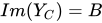
    3. The capacitor's admittance Failed to parse (MathML with SVG or PNG fallback (recommended for modern browsers and accessibility tools): Invalid response ("Math extension cannot connect to Restbase.") from server "https://wikimedia.org/api/rest_v1/":): {\displaystyle Y_C} is given by Failed to parse (MathML with SVG or PNG fallback (recommended for modern browsers and accessibility tools): Invalid response ("Math extension cannot connect to Restbase.") from server "https://wikimedia.org/api/rest_v1/":): {\displaystyle Y_C=\frac{1}{Z_C}} , where the Failed to parse (MathML with SVG or PNG fallback (recommended for modern browsers and accessibility tools): Invalid response ("Math extension cannot connect to Restbase.") from server "https://wikimedia.org/api/rest_v1/":): {\displaystyle Re(Y_C)=G} (the conductance) and the Failed to parse (MathML with SVG or PNG fallback (recommended for modern browsers and accessibility tools): Invalid response ("Math extension cannot connect to Restbase.") from server "https://wikimedia.org/api/rest_v1/":): {\displaystyle Im(Y_C)=B} (the susceptance). Calculate Failed to parse (MathML with SVG or PNG fallback (recommended for modern browsers and accessibility tools): Invalid response ("Math extension cannot connect to Restbase.") from server "https://wikimedia.org/api/rest_v1/":): {\displaystyle G} .
    4. Read section 13.1 (pages 106-107) in this [paper].
    5. Calculate the relative permittivity Failed to parse (MathML with SVG or PNG fallback (recommended for modern browsers and accessibility tools): Invalid response ("Math extension cannot connect to Restbase.") from server "https://wikimedia.org/api/rest_v1/":): {\displaystyle \epsilon_r} as Failed to parse (MathML with SVG or PNG fallback (recommended for modern browsers and accessibility tools): Invalid response ("Math extension cannot connect to Restbase.") from server "https://wikimedia.org/api/rest_v1/":): {\displaystyle \epsilon'_r=\frac{C}{C_{air}}} and Failed to parse (MathML with SVG or PNG fallback (recommended for modern browsers and accessibility tools): Invalid response ("Math extension cannot connect to Restbase.") from server "https://wikimedia.org/api/rest_v1/":): {\displaystyle \epsilon''_r=\frac{G}{\omega C_{air}}} .
    6. Do the above procedure for three frequencies at 0.1 MHz, 1MHz and 10 MHz.
    7. Plot Failed to parse (MathML with SVG or PNG fallback (recommended for modern browsers and accessibility tools): Invalid response ("Math extension cannot connect to Restbase.") from server "https://wikimedia.org/api/rest_v1/":): {\displaystyle \epsilon'_r} and Failed to parse (MathML with SVG or PNG fallback (recommended for modern browsers and accessibility tools): Invalid response ("Math extension cannot connect to Restbase.") from server "https://wikimedia.org/api/rest_v1/":): {\displaystyle \epsilon''_r} as a function of frequency.


Beyond 10MHz lumped circuits become non-ideal (resistors start exhibiting capacitive and inductive effects - analogously with capacitors and inductors - even plain wires). So, to go beyond 10MHz, we need to abandon the lumped capacitance model for determining the permittivity. There are a few techniques for doing this. And the transmission-line technique is one of them.

Transmission Line Techniques (above 50MHz)

coming soon...